©Marco Salvatori Design
P.IVA 01354440339


Our products ranges from control units for vehicle control to those specific for the management of the anti-tipping system thanks to the redundancy guaranteed by the use of 3 microcontrollers, to the control units dedicated to remote connection to the machine.
The development of each product is done internally using the most recent technologies in the electronics field. Each control unit is subjected to rigorous automated testing that tests its resources by issuing a compliance report, all managed by internally developed software. Do not hesitate to contact us if you do not find the answer to your needs in standard production.
We are able to develop custom products according to customer specifications, from hardware design to software development, all aimed at achieving your goals, both technical and economic. Thinking also about the design of our products it is possible to obtain customized serigraphies according to customer specifications.
Our remote control system allows, using a web interface, the monitoring and geolocation of different types of vehicles (agricultural vehicles, sweepers, container handling).
Through a dedicated control unit (RCU) installed on the vehicle, it is possible to transfer machine data to a remote server on which the storage is carried out.
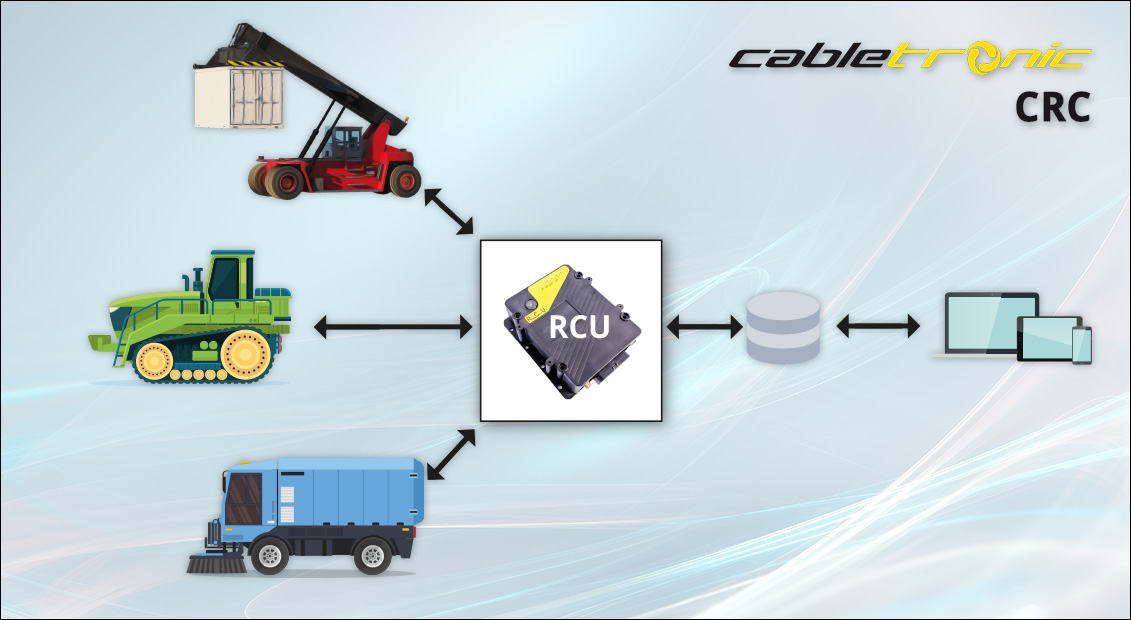
Features available with the Cabletronic Remote Control:
Control unit developed for 12V systems, equipped with dual 32-bit microcontroller has a considerable number of configurable inputs/outputs, H-bridges, inertial sensors and 2 can lines. Designed to meet the needs of agricultural and industrial applications.
It is the perfect control unit for various fields of application, from the automotive and industrial vehicle sectors to all those contexts in which an extremely powerful control unit is required, reliable and capable of responding even to immediate unforeseeable needs; thanks to its modularity, it can play a dual role, both as a master and a slave. This allows you to create an extensive network to better manage all usage contexts.
It is the small sister control unit of the CCU24I30O. At the level of computing power they are equivalent, it is different for fewer resources and obviously for the lower price. It can be used as a slave to the CCU24I30O if the latter's resources were not sufficient but the addition of a second CCU24I30O was excessive.
A smaller variant of the CCU24/30 featuring a double 32-bit microcontroller. It differs for its fewer resources allowing for a smaller cost. Can be paired with a CCU24/30 whenever a single CCU24/30 is not sufficient but including two would be wasteful.
Control unit specifically developed for the management of the anti-tipping system and all those functions for which it is essential to be able to guarantee 100% safety: this is possible thanks to the redundancy provided by the use of 3 microcontrollers that work in symbiosis.
Remote control unit for the vehicle used to transmit data to our diagnostic CRC system and to allow remote programming / parameterization of the control units on the machine.

Remote vehicle management MCU able to transmit data to our proprietary CRC diagnostic cloud system or to third-party systems. It also enables OTA flashing of the vehicle's MCUs.

It's our new creature: equipped with 2 very powerful 32bit processors and a considerable amount of inputs / outputs. It is suitable for all those applications for which it is preferable to have all the intelligence concentrated in a control unit rather than having a distributed system of several control units. In the case of particularly complex systems that require a high number of inputs / outputs, it can obviously be associated with other control units to create an extended network in which all the boards communicate in CAN Bus.

This MCU features 5 CAN lines as well as 4 input and 4 output pins. This allows it to interface with third-party systems without exposing their proprietary protocols. It is possible to pick which CAN messages are to be used as inputs and to define their output message mappings.

It is the smallest of our control units, suitable for those situations where the number of inputs to be read or outputs to be managed is very small or in addition to a control unit with more resources.